

Many lifters use 1RM and PR as if they mean the same thing. They don’t. That mix-up can wreck a good training plan.
Quick answer: your 1RM (one-rep max) is the most weight you can lift for one clean rep today. Your PR (personal record) is the best lift you have ever completed. This guide shows how 1RM vs. PR in lifting differ, how to measure each, and which one to train with.
Table of Contents
What Are 1RM and PR in Lifting?
The two terms sound close, but they measure different things. Here is each one in plain words.
What is 1RM? Your one-rep max is the heaviest weight you can lift for one rep with good form right now. It reflects your current strength. It moves with sleep, food, stress, and fatigue. And you don’t have to lift it to have it.
What is a PR in weight lifting? A personal record is your best result on a lift. Many lifters say personal best (PB) instead. A PR only counts if you complete it. It stays on your record until you beat it.
PRs come in more than one form:
- The heaviest single (one rep)
- More reps with the same weight
- The same reps with a heavier weight
- The same weight moved faster (bar speed)
That means you can own a 5-rep PR and a 10-rep PR on the same lift.

There is a third label too: estimated 1RM (e1RM). It is a prediction from a multi-rep set, not a tested single. Powerlifting, weightlifting, strongman, bodybuilding, and CrossFit athletes all use these terms.
Understanding the difference between a PR and a 1RM becomes much easier once you know exactly how a one-rep max is defined and measured. For a deeper foundation, explore this guide to what one rep max (1RM) means and how it fits into strength training.
Key Differences Between 1RM and PR
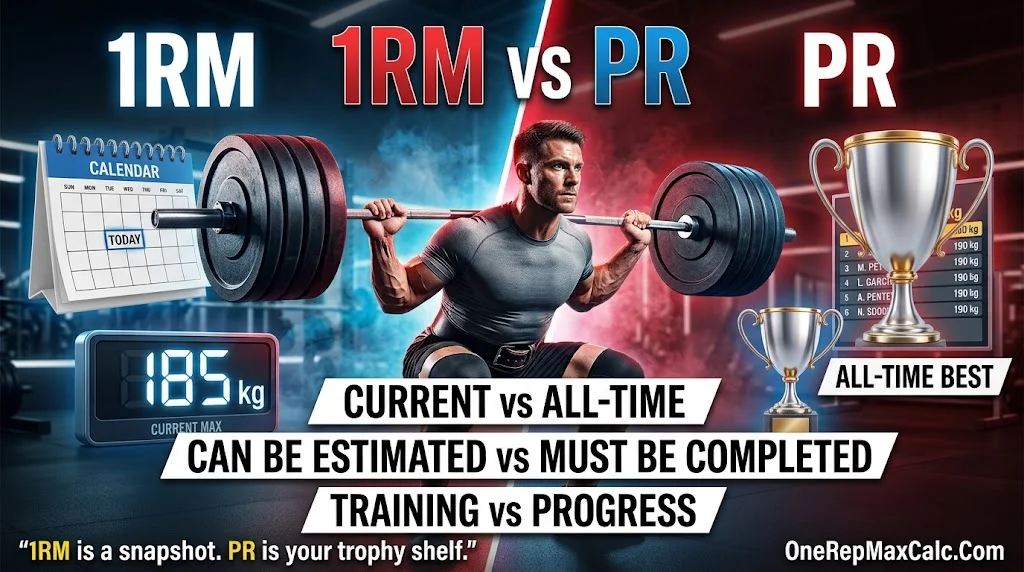
Think of your 1RM as a snapshot and your PR as a trophy shelf. One shows today. The other shows your history.
| Feature | 1RM | PR |
| Time frame | Right now | All-time best |
| Must you lift it? | No, it can be estimated | Yes, it must be completed |
| How many per lift | One | Many (one per rep range) |
| How it changes | Can shift day to day | Changes only when you beat it |
| Best use | Picking training weights | Tracking progress |
Here are three real cases.
- 1RM equals PR. You hit a new all-out single. It is both your PR and your 1RM that day.
- 1RM is lower than PR. Your squat PR is 315 lb. After four months off, your max is 275 lb. Your PR stays at 315 lb. Your plan should start from 275 lb.
- 1RM is higher than PR. Your bench PR is 225 lb. Today you bench 195 lb for 8 reps. That points to an e1RM near 245 lb. Your PR is still 225 lb until you lift more.
Max strength can move fast. In a 2016 case series, three competitive lifters squatted a max for 37 straight days. Their 1RMs rose between 2.3% and 10.8%. That was a small group of experienced athletes, so don’t copy it.
One more split matters: gym PR vs. competition PR. In meets run by USA Powerlifting, an IPF affiliate, a lift needs at least two of three white lights. Squat depth is strict: the hip crease must drop below the top of the knee. A shallow gym PR may not count on the platform.
Understanding your true strength level starts with knowing your one-rep max, so you can calculate your 1RM accurately and use it to set smarter training goals and track progress over time.
How to Calculate and Track Your 1RM and PR
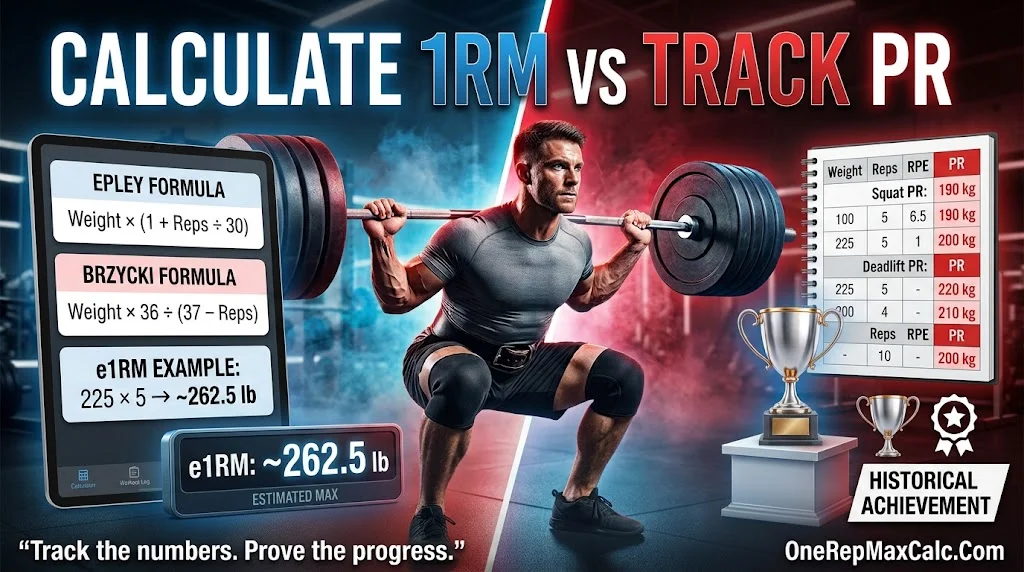
You can estimate your 1RM with math. You track your PR with a log.
Two common formulas power most 1RM calculators:
- Epley formula: weight × (1 + reps ÷ 30)
- Brzycki formula: weight × 36 ÷ (37 − reps)
Try 225 lb for 5 reps. Epley gives about 262.5 lb. Brzycki gives about 253.1 lb. A gap of a few pounds is normal. Pick one formula and stay with it.
Keep the set small. A 2006 study found 5-rep sets predicted 1RM best. It advised using no more than 10 reps. Very high-rep sets measure muscular endurance, not maximal strength.
Direct testing works too. A review of 32 studies with 1,595 people found the 1RM test has good-to-excellent reliability. The median ICC was 0.97. Yet a true max still adds fatigue and injury risk.
Test safely:
- Warm up with ramp-up sets that get heavier in small steps.
- Use a spotter or safety bars.
- Rest several minutes between heavy attempts.
- Skip max singles if you are new. Use rep PRs instead.
Test after a full training block, not every week. Beginners set PRs almost every session by adding small plates, so they rarely need a max test.
Log every set in a workout log or app. Record weight, reps, and effort (RPE or RIR). Note belts, straps, pauses, and depth. Those details keep your numbers honest.
How to Use 1RM vs. PR in Lifting in Your Training
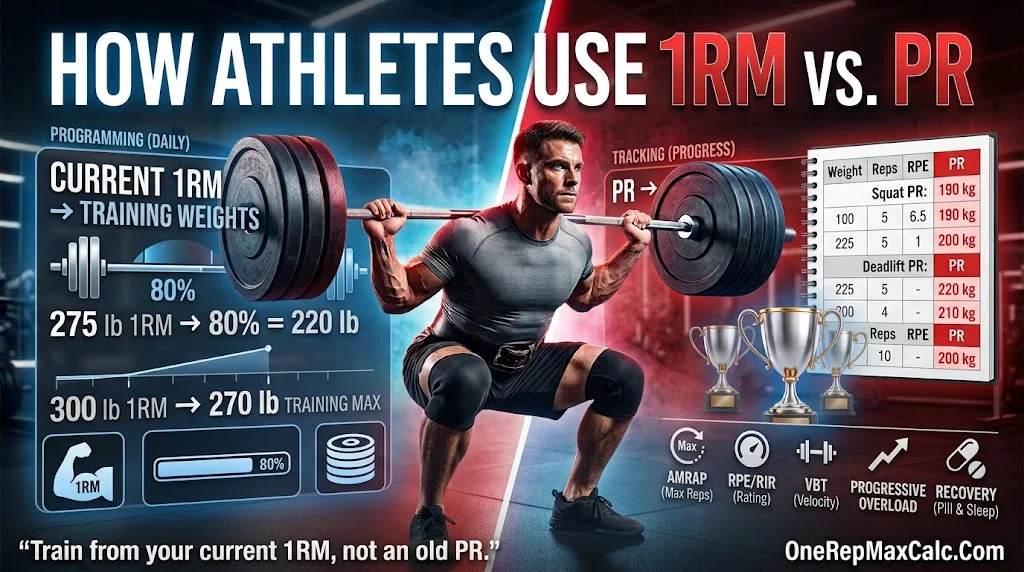
The rule is simple: program from your current 1RM, not your PR. An old PR can push you into weights you can’t handle today.
Most percentage-based training uses 1RM. If your 1RM is 275 lb, 80% is 220 lb. That is your working weight.
Some programs go one step further. Jim Wendler’s 5/3/1 uses a training max, set near 90% of your true 1RM. If your max is 300 lb, your training max is 270 lb. It keeps reps smooth and recovery steady.
Use effort ratings as a check. If 80% feels like your hardest possible set, your 1RM number is too high. Lower it.
Other tools help too:
- AMRAP sets (as many reps as possible) test strength without a single.
- Velocity-based training (VBT) tracks bar speed to show daily readiness.
- Progressive overload keeps new PRs coming.
Avoid these common mistakes:
- Training from a stale PR
- Guessing a 1RM that is too high
- Testing too often
- Ignoring rep-range PRs
- Comparing your numbers to someone else’s
- Skipping rest and sleep
Set clear goals. For example: add 10 lb to your squat 1RM in 12 weeks.
FAQs
What does “100kg PR” mean in weightlifting?
It means your best completed lift on a given exercise is 100 kilograms, about 220 lb. Always name the lift and the reps. A 100 kg squat PR and a 100 kg bench PR are very different feats.
Does 1 rep count as a PR?
Yes. A single is the most common PR. But any new best counts, including more reps, more weight at the same reps, or a faster bar.
What is the 3-3-3 rule in gym?
It is a workout-structure idea, not a 1RM or PR rule. One popular version is three days of strength, three days of cardio, and three days of rest or easy recovery. Another version means three exercises, three sets, and three training days a week. The meaning varies, so check which one a program uses.
What is PR in weight lifting?
A PR is your personal record: the best performance you have completed on a lift. It is usually the heaviest weight, and it stands until you beat it.
Conclusion
Your PR shows how far you have come. Your 1RM shows where to train today. Track both, train from your current 1RM, and let each new PR prove your progress.

Sohail Abroy is a dedicated blogger and content creator who focuses on creating useful, engaging, and easy-to-understand online content. He enjoys researching topics, simplifying information, and sharing practical insights that readers can apply in everyday life.