
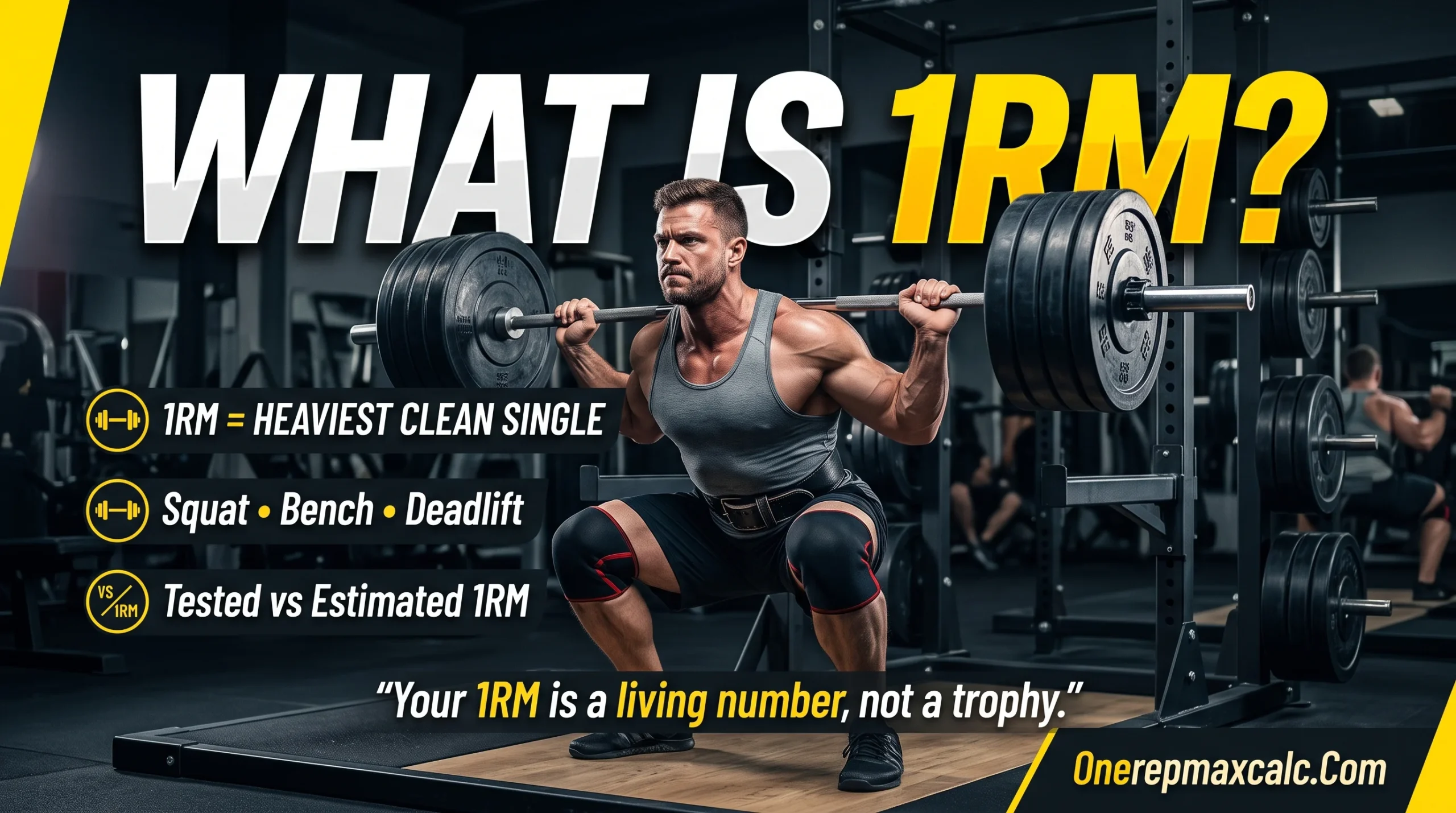
One rep max (1RM) is the heaviest weight you can lift once, with good form, on a given exercise. Every plan that says “lift 80% of your max” depends on it.
Most beginners don’t know their max. This guide explains what is one rep max, how to find it safely, and how to use it to get stronger.
Table of Contents
What Is One Rep Max (1RM) and Why Does It Matter?
Your 1RM is a snapshot of your top strength on one lift. Here is what counts and what doesn’t.
What is a one rep max? It is one full rep with a full range of motion, a clean lockout and no help. No bouncing the bar off your chest. No half squats.
Your 1RM is not one number for your whole body. Your squat, bench press and deadlift each have their own.
There are two kinds:
- Tested 1RM: the weight you actually lifted once.
- Estimated 1RM (e1RM): a prediction from a lighter set of several reps.
You will also see 3RM and 5RM. These mean the most weight you can lift for 3 or 5 reps.
The idea comes from powerlifting and Olympic weightlifting, where the heaviest single decides the winner. Gyms later borrowed it for percentage-based training and tracking progressive overload.
Your 1RM also moves. In a 2016 study, three powerlifters tested their max every day for 36 days. Their numbers swung widely. Sleep, stress and even caffeine can shift your strength.
So treat your 1RM as a living number, not a trophy.
Should beginners test a true max? Usually no. New lifters gain strength fast, so a max goes stale within weeks. Technique also breaks down under heavy loads. Estimating is safer.
In the US, a standard Olympic barbell weighs 45 lb (20 kg). Remember this when you add up your plates.
Once you understand how 1RM works, the next step is applying it to your own training numbers and tracking your strength more accurately. For a more advanced approach, use an elite one rep max calculator to estimate your maximum strength and guide your workout planning.
How to Calculate Your One Rep Max (1RM) Safely
You can lift your max or estimate it. For most people, estimating is the smarter pick.
How do I calculate my one rep max? Pick a main lift. Do one hard set of 3 to 8 reps, close to failure. Then plug the weight and reps into a formula or a 1RM calculator.
Estimates work best under 10 reps. After that, muscular endurance starts to cloud the result. Estimates can also miss by 10% or more, so use them as a guide.
Research shows that adding age, height, weight or body fat to the math does not improve accuracy. A good set and a good formula are enough.
How do you test a 1RM? Direct testing is the most accurate method. It is also slow and tiring, according to exercise science research. Follow these steps:
- Warm up with 5 to 10 minutes of light cardio and dynamic moves.
- Ramp up with lighter sets and fewer reps, such as 5, 3, then 2.
- Use a spotter or safety pins. Never test alone.
- Add small jumps. Go up 5 to 10 lb (about 5 to 10%) for upper-body lifts.
- Rest 3 to 5 minutes between attempts so you can lift fresh.
- Stop early. Three or four heavy attempts are plenty. Quit at the first miss or the first ugly rep.
Test only big, stable lifts like the squat, bench press, deadlift and overhead press. Skip curls, lateral raises and leg extensions. They are not built for max tests.
If you are older or have sore joints, check with a doctor or qualified coach first.
Estimated 1RM Formulas: Epley vs. Brzycki
Two formulas lead the pack: Epley and Brzycki. Both give close answers.
- Epley: weight × (1 + reps ÷ 30)
- Brzycki: weight × 36 ÷ (37 − reps)

Here is a 135 lb set run through both:
| Reps at 135 lb | Epley e1RM | Brzycki e1RM |
|---|---|---|
| 5 | 158 lb | 152 lb |
| 8 | 171 lb | 168 lb |
| 10 | 180 lb | 180 lb |
They match at 10 reps. Below that, Epley runs a little higher.
Neither one is perfect. Pick one and stick with it. Your trend over time matters more than any single number. Then round to weights you can actually load, like the nearest 5 lb.
How to Use Your 1RM for Strength, Muscle and Smarter Training
Your max tells you how heavy to go. Different intensity zones build different results.
The NSCA gives these guidelines:
- Muscular strength: 4 to 6 reps at 85% of 1RM or more.
- Muscular hypertrophy (muscle size): 6 to 12 reps at 67 to 85%.
- Muscular endurance: 12 or more reps below 67%.
- Power: lighter loads, about 30 to 60%, moved fast.

Here is a rough guide to how many reps each percentage of 1RM allows:
| % of 1RM | Reps you can usually do |
|---|---|
| 100% | 1 |
| 94% | 3 |
| 89% | 5 |
| 81% | 8 |
| 75% | 10 |
| 67% | 15 |
Now see it in action. Say your bench press 1RM is 150 lb. A simple four-week block could look like this:
- Week 1: 4 sets of 6 at 75% (about 112 lb, so load 110 or 115 lb)
- Week 2: 4 sets of 5 at 80% (120 lb)
- Week 3: 3 sets of 4 at 85% (about 127 lb, so load 125 or 130 lb)
- Week 4: 3 sets of 3 at 90% (135 lb)
Coaches often use Prilepin’s chart for this. It suggests 2 to 4 reps per set in the 80 to 90% range. That keeps the weight heavy without turning every rep into a grind.
How often should you retest your 1RM? Re-estimate every few weeks from a hard working set. Save true max tests for experienced lifters, no more than every 8 to 12 weeks.
Avoid these common mistakes:
- Using an old max that no longer fits.
- Letting your ego pick the weight.
- Estimating from a 15-rep set.
- Chasing a 1RM on isolation lifts.
If percentages feel confusing, use RPE (rate of perceived exertion) or “reps in reserve” instead. Advanced lifters can even track bar speed with velocity-based training (VBT). Both let you adjust the load on the day, based on how strong you feel.
FAQs
Does 1RM mean 1 rep max?
Yes. 1RM stands for one rep max, also written one-rep max or one repetition maximum. It is the most weight you can lift for a single clean rep. The “RM” part also works for other counts, like 3RM or 5RM.
How much should a 70 kg man bench press?
A 70 kg man weighs about 154 lb. Training logs from 24,408 lifters put a 70 kg man at about 46 kg (101 lb) as a beginner, 64 kg (141 lb) as a novice, 78 kg (172 lb) as intermediate, 94 kg (207 lb) as advanced and 127 kg (280 lb) as elite. You can check the full bench press standards table.
A common first goal is to bench your own bodyweight. For him, that is about 154 lb. Age, training history and body build all change the answer.
How do I calculate my one rep max (1RM)?
Do a hard set of 3 to 8 reps. Then use the Epley formula: weight × (1 + reps ÷ 30). For example, 135 lb for 8 reps gives about 171 lb. Or enter your numbers into a 1RM calculator.
What’s a good 1 rep max?
It depends on your bodyweight, sex, age and experience. There is no single “good” number for everyone. For men, common intermediate markers are a bench press near 1× bodyweight, a squat near 1.5× and a deadlift near 2×. Your own steady climb matters more than any online chart.
Conclusion
Your one rep max (1RM) is a tool, not a test of ego. Estimate it from a hard set, update it often and use it to set smart weights. Start with one lift, one formula and one four-week plan. Then watch your numbers climb.

Sohail Abroy is a dedicated blogger and content creator who focuses on creating useful, engaging, and easy-to-understand online content. He enjoys researching topics, simplifying information, and sharing practical insights that readers can apply in everyday life.